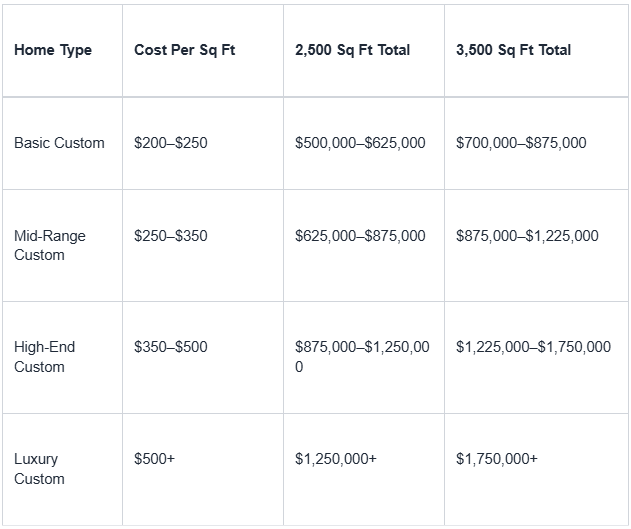
Custom home construction costs typically range from $200 to $500+ per square foot depending on location, materials, finishes, and complexity. This includes construction but often excludes land, extensive site work, and certain permit fees.
Building a custom home represents one of the biggest financial decisions you'll ever make. Unlike buying an existing property, custom construction involves hundreds of variables that directly impact your final price tag. Understanding these costs upfront helps you set realistic expectations and make informed decisions throughout the building process.
Key Takeaways
- Custom home construction costs range from $200 to $500+ per square foot depending on location, finishes, and complexity
- Land, site preparation, utilities, and permits often add 20-35% to the base construction cost
- High-end finishes and custom features can increase costs by 30-60% compared to standard builds
- Cost per square foot varies dramatically based on home size, with smaller homes costing more per square foot
- Regional differences, labor availability, and market conditions create significant price variations
- Hidden costs like temporary utilities, landscaping, and design changes frequently push budgets 10-15% higher than initial estimates
Understanding the Base Cost to Build a Custom Home
The national average cost to build a custom home sits between $350,000 and $700,000 for most projects. This translates to roughly $200 to $350 per square foot for a standard custom build with quality mid-range finishes. High-end luxury homes can easily exceed $500 per square foot or more.
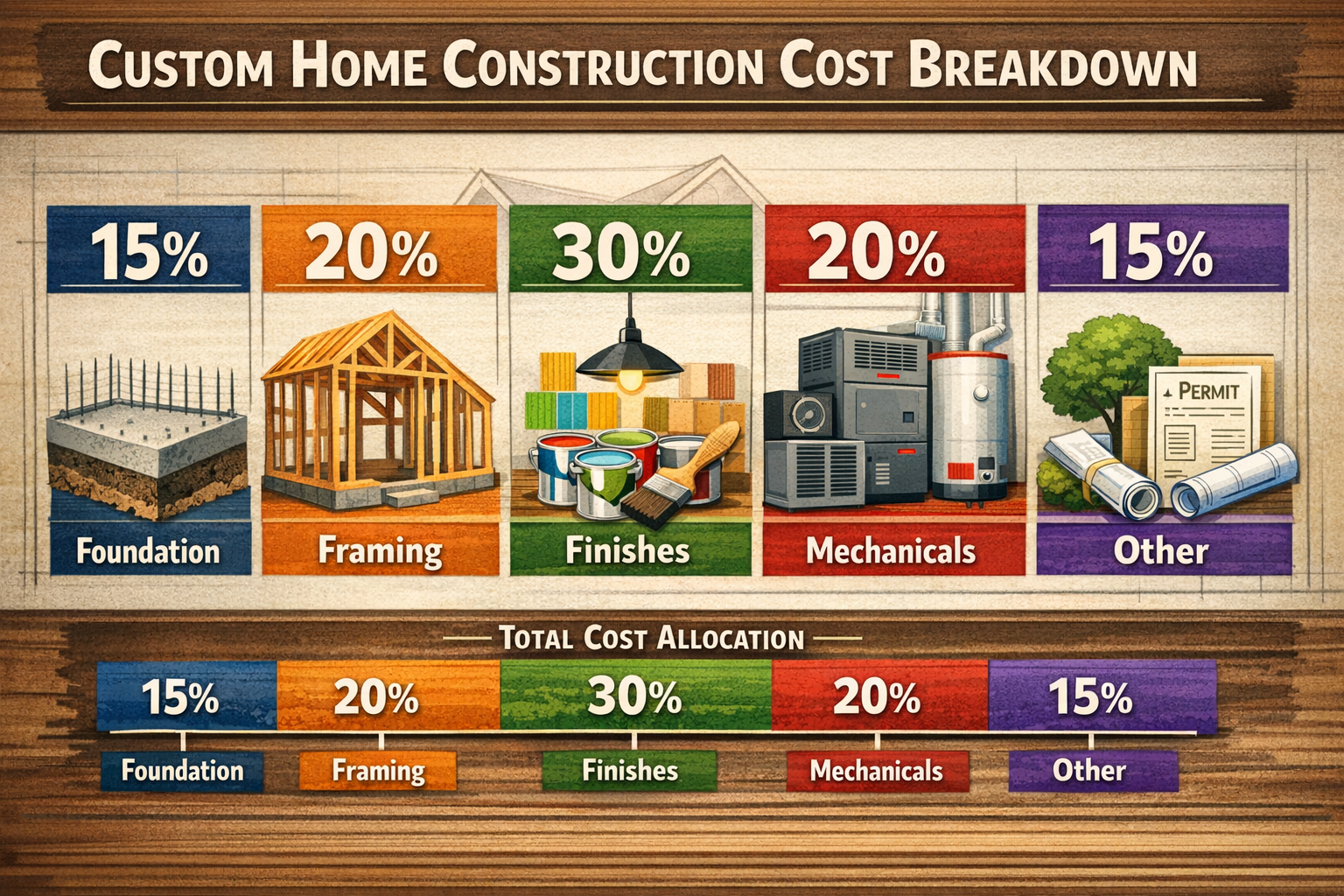
The baseline construction cost covers framing, foundation, roofing, exterior finishes, interior finishes, mechanical systems, and basic landscaping. It's the pure construction expense before adding land, extensive site work, or premium upgrades.
What's Actually Included in Your Custom Home Cost
Most builders quote a price that covers the physical structure and interior finishes. This typically includes site preparation, foundation work, framing, roofing, siding, windows, doors, insulation, drywall, flooring, cabinetry, countertops, plumbing fixtures, electrical systems, HVAC, and basic interior paint.
Standard construction contracts also cover builder's risk insurance, construction management fees, and basic landscaping like grading and seeding. Your builder's overhead and profit margin are built into the per-square-foot price.
What Usually Isn't Included
- Land purchase and closing costs
- Extensive site work beyond basic grading
- Well and septic systems if not on municipal services
- Long driveway construction or special access roads
- Permit fees, impact fees, and utility connection charges
- Architect and engineer fees for custom design work
- Upgraded appliances, fixtures, and custom millwork
- Elaborate landscaping, outdoor kitchens, or pools
- Furnishings and window treatments
When you build a custom home, these exclusions can add 25-40% to your base construction cost. Always get a detailed breakdown of what's included before signing contracts.
Major Factors That Drive Your Custom Home Budget
Location and Regional Cost Variations
Labor costs vary dramatically by region, with coastal markets and major metros running 30-50% higher than rural areas. Material costs also fluctuate based on distance from suppliers and local building code requirements.
Site conditions play a huge role too. Building on a flat, cleared lot with easy access costs significantly less than constructing on steep terrain, wooded property, or locations requiring extensive foundation work due to soil conditions.
Home Size and Design Complexity
Here's a counterintuitive fact: smaller homes cost more per square foot than larger ones. A 1,500 square foot custom home might run $300 per square foot, while a 4,000 square foot home costs $250 per square foot because fixed costs like kitchens, bathrooms, and HVAC systems are spread over more space.
Complex designs with multiple roof lines, unusual angles, extensive windows, or challenging architectural features increase labor hours and material waste. Simple rectangular designs with straightforward rooflines cost less to build than homes with complicated geometries.

Material and Finish Selections
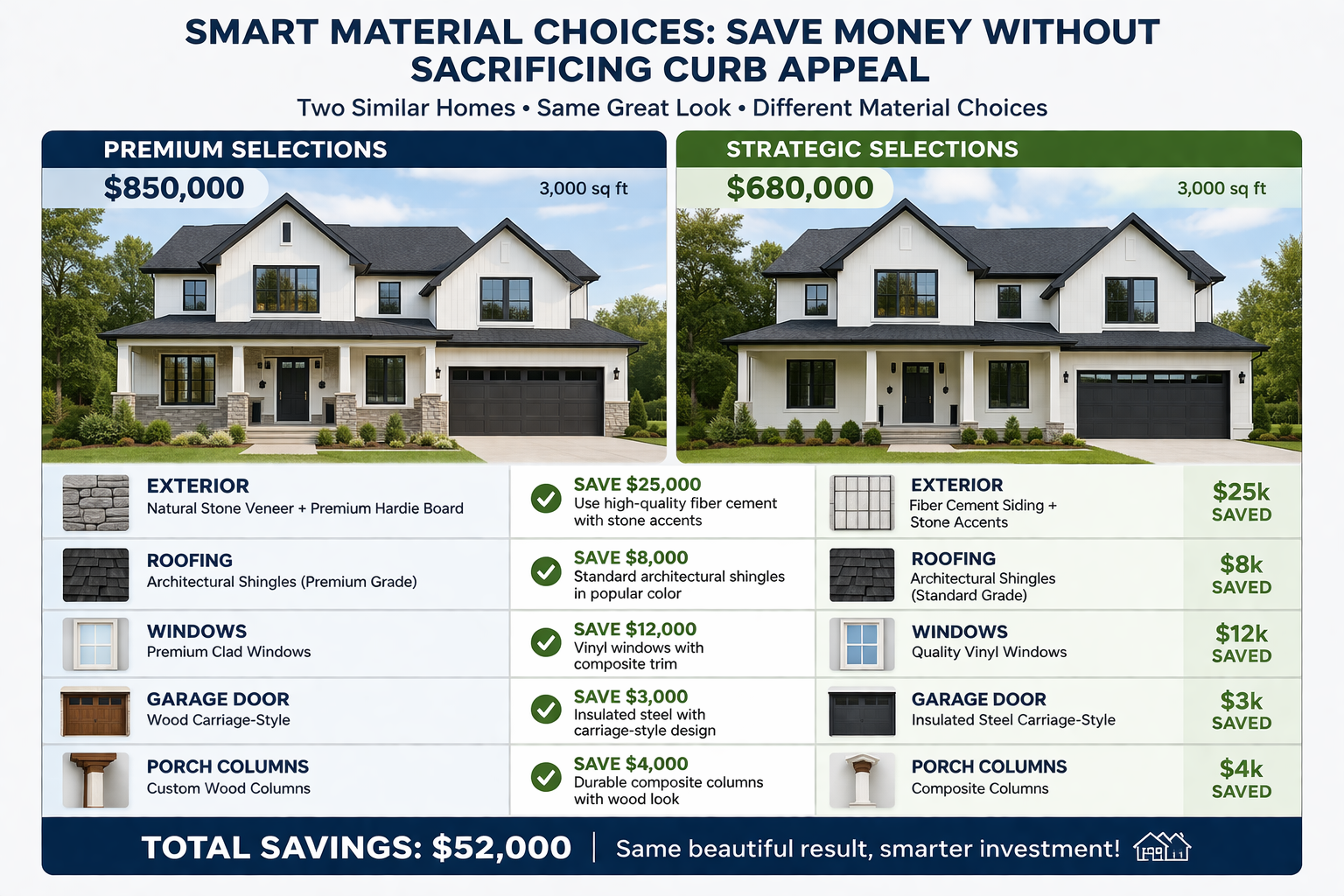
Your finish selections create the widest price swings in custom home construction. Choosing premium materials throughout your home can increase total costs by 40-60% compared to standard builder-grade options.
Kitchens and bathrooms drive costs higher faster than any other rooms. A basic kitchen might cost $25,000 while a high-end kitchen with custom cabinetry, premium appliances, and luxury countertops runs $80,000 to $150,000 or more. Multiply that by the number of bathrooms and specialty spaces you're including.
Building Systems and Technology
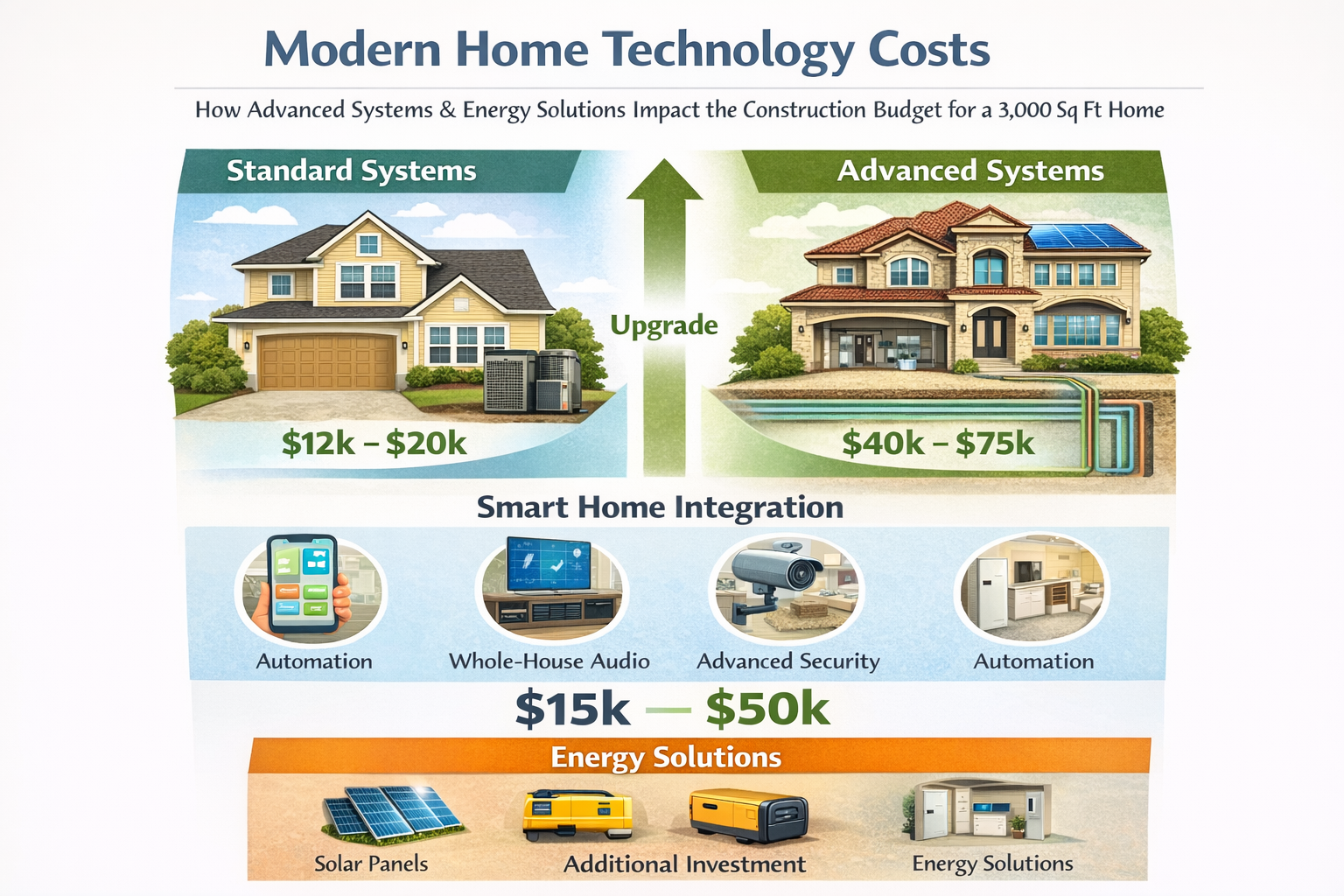
Modern homes incorporate more sophisticated systems than ever before. Standard HVAC installation costs $12,000 to $20,000, but energy-efficient custom homes with geothermal systems or multi-zone climate control can cost $40,000 to $75,000.
Smart home integration, whole-house audio, advanced security systems, and home automation add $15,000 to $50,000 depending on the sophistication level. Solar panels, backup generators, and other energy systems represent additional investments.
Hidden Costs That Catch Homeowners Off Guard
Most custom home projects exceed initial budgets by 10-20% due to unexpected costs, design changes, and upgrades discovered during construction. Building in a 15-20% contingency protects against budget overruns.
Permit and impact fees vary wildly by jurisdiction, ranging from $5,000 in rural areas to $50,000 or more in some municipalities. Utility connection fees for water, sewer, gas, and electric can add $10,000 to $40,000 depending on distance from existing infrastructure.
Temporary Costs During Construction
- Temporary utilities and construction power: $2,000–$5,000
- Portable toilets and dumpsters: $1,500–$3,000
- Temporary fencing or security: $1,000–$3,000
- Construction loan interest and fees: varies by loan amount and duration
- Temporary housing if selling existing home: depends on the custom home building timeline
Common Mistakes That Inflate Custom Home Costs
- Underestimating site work expenses, especially on challenging terrain or when utilities are far from the build site
- Making design changes after construction begins, which triggers change orders and delays
- Choosing complex architectural features without understanding the labor premium they command
- Failing to budget adequately for landscaping, which often costs 5-10% of total home value
- Not accounting for financing costs during construction, which can add thousands monthly
- Skipping the contingency fund, leaving no buffer for unexpected issues or upgrades
How Custom Home Costs Compare to Buying Existing Homes
In many markets, building custom costs 10-30% more than purchasing a comparable existing home. However, you're getting exactly what you want, with modern systems, current building codes, warranties on all components, and no immediate repair or luxury home renovation needs.
The price gap narrows in hot markets where existing home inventory is limited and prices have surged. In some cases, building new becomes competitive with buying, especially if you already own suitable land.

Financing Your Custom Home Construction
Construction loans work differently than traditional mortgages. Most lenders require 20-25% down and offer construction-to-permanent loans that convert to a standard mortgage once building completes. During construction, you typically pay interest-only on the amount drawn.
Your creditworthiness, debt-to-income ratio, and the appraised value of the completed home determine loan approval and terms. Many lenders require detailed construction budgets, builder contracts, and architectural plans before approving financing.
Ways to Control Custom Home Building Costs
Start with a realistic budget that includes contingencies. Work with your builder to identify value engineering opportunities where you can achieve similar results with less expensive approaches. Simple changes in materials or methods can save thousands without compromising quality.
Prioritize your must-haves versus nice-to-haves. You can always add features later, but removing them after construction begins triggers expensive change orders. Lock in your design before breaking ground.
Smart Cost-Saving Strategies
- Choose a simpler floor plan with rectangular shapes and minimal roof complexity
- Reduce the overall square footage while maintaining the rooms you need most
- Use standard window and door sizes rather than custom dimensions
- Limit the number of plumbing fixtures by stacking bathrooms vertically
- Select mid-range finishes in secondary spaces while splurging on key areas like the kitchen
- Consider doing some finish work yourself if you have the skills and time
- Build in phases, starting with essential spaces and adding features later
Frequently Asked Questions
What is the realistic cost per square foot for a custom home today?
Realistic custom home costs range from $200 to $500 per square foot in most markets, with $250 to $350 representing the middle range for quality construction. Coastal and high-cost urban areas push costs 20-40% higher, while rural locations with lower labor costs trend toward the bottom of this range. These figures reflect construction only and don't include land, extensive site work, or premium upgrades.
Why is there such a huge price difference per square foot between builds?
Price variations stem from dozens of factors working in combination. Location drives labor and material costs differently across regions. Home size matters because smaller homes have higher per-square-foot costs due to fixed expenses. Design complexity affects labor hours dramatically. Material quality ranges from builder-grade to luxury-tier products. Site conditions require varying levels of foundation and preparation work. Finally, the level of finishes and included features creates the widest swings in final pricing.
Does the cost per square foot include land, permits, and utilities?
Standard per-square-foot pricing typically covers only the physical construction of the home itself. Most builders exclude land purchase, extensive site preparation beyond basic grading, utility connection fees, permit and impact fees, architect fees, and landscaping beyond basic seeding. Always request a detailed breakdown showing what's included and what you'll need to budget separately. These excluded costs often add 25-40% to the base construction price.
How much do upgrades and high-end finishes increase the final cost?
High-end finishes and premium upgrades typically increase construction costs by 30-60% compared to standard builder-grade materials. A kitchen upgrade alone can add $40,000 to $100,000, while premium flooring throughout adds $20,000 to $50,000. Custom millwork, luxury fixtures, smart home systems, and architectural details accumulate quickly. Most homeowners who start with upgrade intentions should budget an additional 40-50% beyond base construction costs to accommodate their desired finish level.
Is cost per square foot even a reliable way to estimate a custom home?
Cost per square foot provides a rough starting point but shouldn't be your only planning tool. It's useful for comparing similar homes in the same market, but it oversimplifies the complexity of custom construction. A 2,000 square foot home with luxury finishes costs more than a 3,500 square foot home with basic materials. Use per-square-foot figures as initial benchmarks, but develop a detailed line-item budget with your builder based on your specific design, site conditions, and material selections for accurate planning.
Planning Your Custom Home Budget Wisely
Building a custom home demands careful financial planning and realistic expectations. Start by understanding the true all-in costs beyond just construction, factor in adequate contingencies, and prioritize features that matter most to your lifestyle. Work with experienced builders who provide transparent pricing and detailed contracts that clearly outline what's included in their quoted costs.
The investment you're making creates a home perfectly suited to your needs with modern systems, energy efficiency, and no immediate repair needs. Done right, custom home construction delivers value that extends far beyond the initial price tag.
Ready to Build Your Dream Home?
Costner Building Group brings decades of experience in custom home construction with transparent pricing and exceptional craftsmanship. Let's discuss your vision and create a realistic budget that brings it to life.
Call us at +1 704 236 6502
Schedule your consultation today and start planning the custom home you've always wanted.